

CircularLIFE4FURN

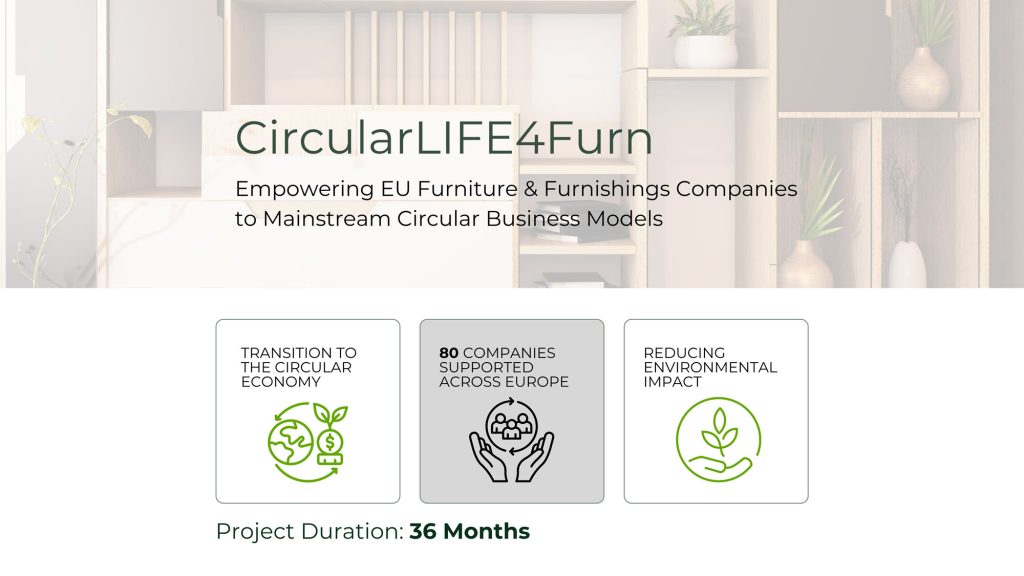
CircularLIFE4Furn aims to accelerate the adoption of Circular Business Models (CBMs) in the European furniture and furnishings industry, supporting SMEs, small mid-cap companies, and micro-enterprises in responding to new European regulations on circular economy and sustainable products. The project seeks to transform the sector into a competitive, resilient, and future-ready ecosystem where circularity becomes standard practice rather than an exception.

The initiative contributes to reducing greenhouse gas emissions, lowering resource consumption, and protecting biodiversity by promoting eco-design, reuse, repair, refurbishment, and recycling of furniture products. At the same time, the project develops practical tools, training programmes, and support mechanisms for companies, facilitating their transition towards sustainable business models aligned with the European Green Deal.

PARTNERS

Coordinator

  • Centre de Difusió Tecnològica de la Fusta i del Moble de Catalunya – AMBIT (Spain)

Project Partners

  • Centro Sperimentale del Mobile e dell’Arredamento – CSM (Italy)
  • Transylvanian Furniture Cluster – TFC (Romania)
  • Interior Cluster Sweden – ICS (Sweden)
  • University of Vaasa (Finland)
  • NutCreatives (Spain)

Associated Partners

  • European Furniture Industries Confederation (EFIC) – Belgium
  • FederlegnoArredo -Italy
  • AMIC – Spain
  • Jönköpings Län – Sweden
  • Agència de Residus de Catalunya – Spain
  • Technological University of the Shannon – Ireland
  • Linnaeus University – Sweden
  • Holon SCCL – Spain
  • Asso Cucine – Italy
  • Marioni SRL – Italy
  • Sigma Technology Solutions – Sweden
  • Fundación Plant for the Planet España – Spain

The Transylvanian Furniture Cluster contributes to the implementation of the project through its direct involvement in analysing the maturity of circular business models, developing tools and resources for SMEs, organising training and mentoring activities, and coordinating the piloting processes supporting companies in their transition towards circular business models.

Furthermore, TFC facilitates the participation of Romanian companies in capacity-building programmes, promotes the exchange of best practices at European level, and supports the development of Communities of Practice dedicated to circular economy approaches within the furniture sector.

TFC’s CONTRIBUTION

Work Package 1: Project Management and Coordination
Coordination of technical and administrative activities, performance monitoring, risk management, and quality assurance throughout project implementation.

Work Package 2: Sector Analysis and Circularity Readiness Assessment
Conducting a European-wide assessment of circular business model adoption, identifying barriers and opportunities, mapping funding mechanisms, and carrying out a study involving at least 100 companies.

Work Package 3: Tool Development and Capacity Building for SMEs
Development of a Digital Toolkit for circular maturity assessment, preparation of a CBM Adoption Handbook, creation of a CBM Online Academy, and organisation of training and certification programmes for companies and advisors.

Work Package 4: Co-design and Piloting of Circular Business Models
Organisation of co-design workshops and mentoring activities for 80 companies, development of tailored circular transition plans, and full implementation in 12 pilot companies.

Work Package 5: Public Policy and Networking
Establishment of national and European Communities of Practice, preparation of policy briefs, and formulation of recommendations related to the implementation of the Ecodesign for Sustainable Products Regulation (ESPR) and the Digital Product Passport (DPP).

Work Package 6: Communication, Dissemination and Exploitation of Results
Organisation of national and international forums, thematic webinars, promotion of success stories, and development of a sustainability and exploitation plan for project results beyond the funding period.

ACTIVITIES
  • At least 100 companies involved in assessing readiness for circular business model adoption;
  • 80 companies participating in co-design and mentoring activities;
  • 12 companies fully implementing circular business model transition plans;
  • A European Handbook for the adoption of Circular Business Models;
  • A Digital Toolkit for maturity assessment and transition planning;
  • A multilingual Online Academy featuring learning modules, case studies, assessments, and other educational resources;
  • At least 100 trained trainers and advisors;
  • A minimum of 15 training and capacity-building activities;
  • 5 Communities of Practice and 12 policy briefs;
  • More than 500 companies using the tools and resources developed within the project.
RESULTS

The project will facilitate the adoption of circular business models in the European furniture sector, contributing to reduced dependency on raw materials and increased resource efficiency.

Training and mentoring activities will support the development of skills required for implementing circular economy principles, contributing to safer, more attractive, and future-oriented jobs.

Through the development of digital tools and learning resources, the project will improve SMEs’ access to knowledge and practical solutions for integrating circularity into their business strategies.

The Communities of Practice and collaboration with relevant European organisations will strengthen dialogue between industry stakeholders and policymakers, contributing to the improvement of public policies related to the circular economy.

EFFECTS

CircularLIFE4Furn will accelerate the adoption of circular business models within the European furniture industry, supporting more than 500 companies in implementing sustainable practices and adapting to new European circular economy requirements.

The project will contribute to reducing environmental impacts by achieving tangible results within pilot companies, including at least a 20% reduction in CO₂ emissions, a minimum 20% decrease in material consumption, a 20% reduction in non-recyclable waste, and at least a 20% increase in the use of renewable or recycled materials.

CircularLIFE4Furn will strengthen circular economy skills by training at least 100 trainers and advisors, engaging over 500 companies in learning and piloting activities, and indirectly benefiting approximately 5,000 employees across the sector.

Through collaboration among clusters, European organisations, and policymakers, as well as the development of 12 policy briefs, the project will contribute to strengthening the European market for sustainable products and services and to making circularity a standard practice within the furniture and furnishings industry.

IMPACT (estimated)